[Back to Red Ribbon Campaign front page]
Israel often says it can find no “partners for peace”, but it is, nevertheless, in the habit of imprisoning those individuals who rise through the ranks to be seen as significant political thinkers and potential leaders.
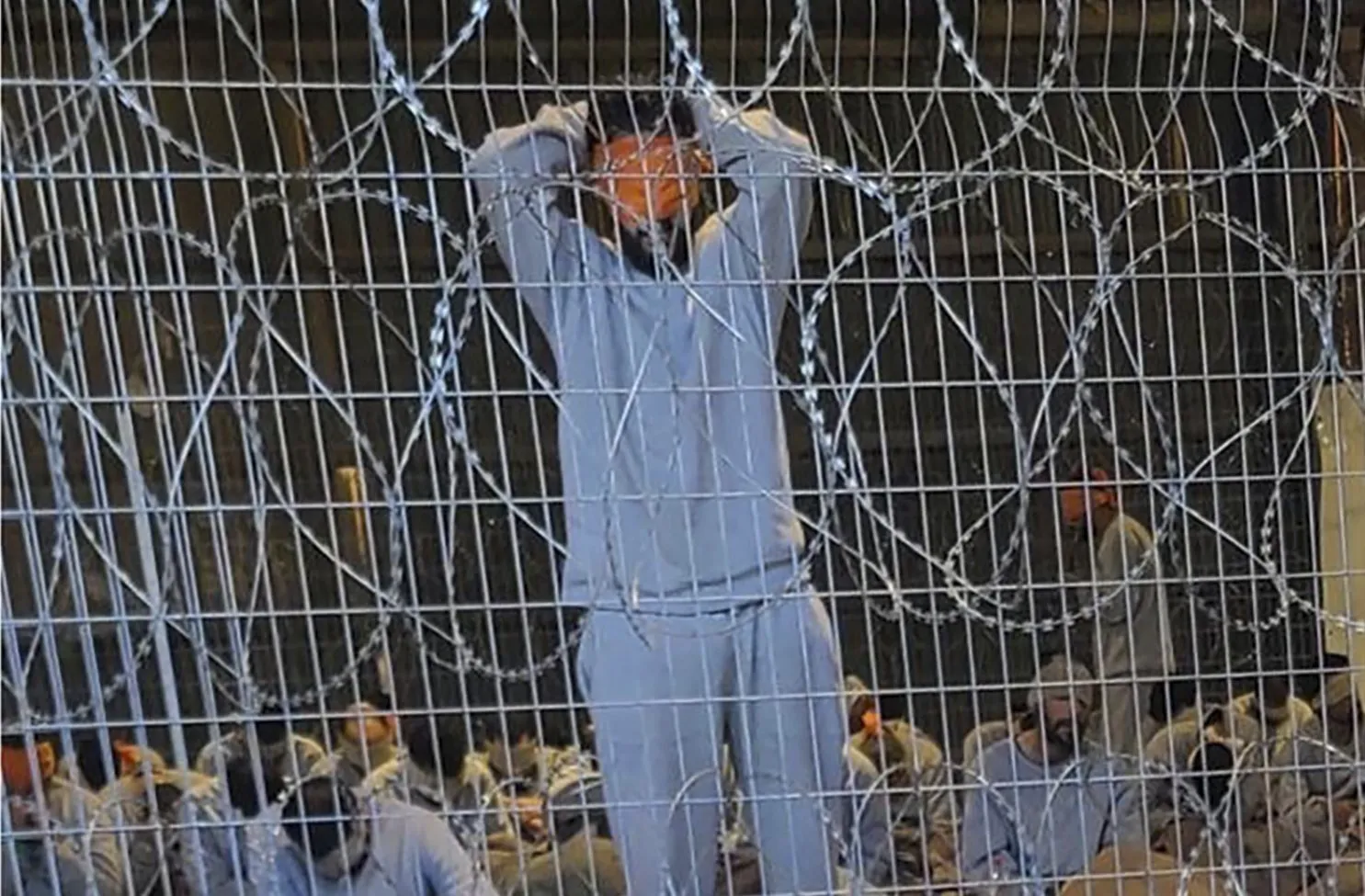
Isolation, denial of proper access to lawyers and family, beatings and abuse of various kinds are part and parcel of the policy of “slow assassination” pursued against the Palestinian prisoners’ leadership inside Israel’s prisons.
Potential leadership prisoners are often singled out for severe abuse, because they are widely admired and respected figures within both the Palestinian prisoners’ movement and society as a whole, as representatives of their people’s resilience, resistance and commitment to achieving liberation.
Walid Daqqa
“It is heart-wrenching that Walid Daqqa has died in Israeli custody despite the many calls for his urgent release on humanitarian grounds following his 2022 diagnosis with bone marrow cancer and the fact that he had already completed his original sentence.” Thus spoke Erika Guevara-Rosas, Amnesty International’s Senior Director for Research, Advocacy, Policy and Campaigns.
Walid, aged 62, was the longest-serving Palestinian prisoner in Israeli jails, whose sentence was extended by 2 years after an appeal for parole was rejected, which meant that he died in prison, not at home. Walid was kept in prison for 38 years.
The Amnesty spokesperson added that Walid’s death “was a cruel reminder of Israel’s systematic medical neglect and disregard for Palestinian prisoners’ rights…Even on his deathbed, Israeli authorities continued to display chilling levels of cruelty… not only denying him adequate medical treatment and suitable food but also preventing him from saying a final goodbye to his wife Sanaa Salameh and their four-year-old daughter Milad. Walid’s death means that he was only allowed to see his daughter Milad once in person, in October 2022, after a daunting legal battle.” (Milad had been conceived by smuggling Walid’s sperm from prison)
Walid Daqqa’s case exemplifies the systematic neglect of prisoners’ health and the absence of any compassionate consideration. Prison authorities routinely delay checkups and urgent surgeries for Palestinian prisoners; specialist doctors are not normally available and “over-the-counter painkillers are administered as a remedy for almost all health problems”, according to a joint report to the United Nations.
Walid Daqqah’s extensive writings behind bars are a testament to a spirit never broken by decades of incarceration and oppression. Walid wrote: “Love is my modest and only victory over my jailer.”
Background: In 1986, Israeli forces arrested Walid Daqqa, then 24 and an Israeli military court sentenced him to life imprisonment after convicting him of commanding a group affiliated to the Popular Front for the Liberation of Palestine (PFLP). The group had abducted and killed Israeli soldier Moshe Tamam in 1984. Daqqa was not convicted of carrying out the murder himself, but of commanding the group, an accusation he always rejected.
Ahmad Sa’adat
Ahmad Sa’adat was born in 1953, the child of refugees from the Nakba of 1948. A maths teacher by training, he has been involved in the Palestinian national movement since 1967, when he became active in the student movement.
In common with so many Palestinians, he was arrested by Israel on numerous occasions. At one point, the Palestinian Authority itself imprisoned him in Jericho for 4 years. Whilst in prison, in January 2006, he was elected to the Palestinian Legislative Council, following the all-Palestine elections, which Hamas won.
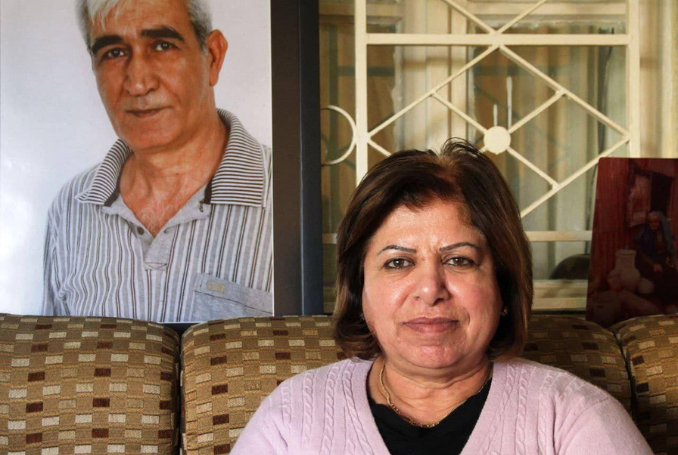
Israeli forces then attacked the Jericho jail and seized him from PA imprisonment, transferring him to their jails, where he is currently serving a 30-year sentence for a range of “security-related” political offences. These charges include membership of a prohibited organization – the Popular Front for the Liberation of Palestine – of which Sa’adat is General Secretary – and incitement, for a speech he made following the Israeli assassination of his predecessor, Abu Ali Mustafa.
More recently, he was moved from isolation in Ramon to isolation in Megiddo Prison and then to isolation in Ganot Prison, where access to family and even to lawyers, is severely limited – so abuse is difficult to expose. He is said to have suffered extreme loss of weight and scabies caused by the denial of clothing changes and of basic hygiene supplies.
Despite all this, he has written a book describing his experiences, called “Echoes of the Shackles.” This will be a lasting record of his imprisonment.
Khalida Jarrar
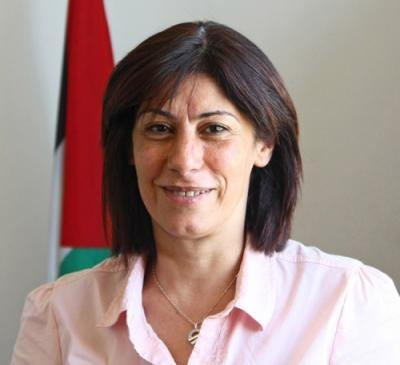
Khalida Jarrar has been politically active since her youth, and her work is especially valued by women in general and women prisoners in particular.
In the 2006 elections, Jarrar was elected as a member of the Palestinian Legislative Council (PLC) on the PFLP ticket. There, she was responsible for the prisoners’ portfolio and the section of the Higher National Committee pushing for Palestine to become a member state in the International Criminal Court.
She herself has been arrested 5 times and, during one period in jail, her daughter died and she was not allowed to attend the funeral.
On release, she spoke at her daughter’s grave, saying, “I will carry on my path until my people—and all peoples of the world—have achieved freedom from colonial domination.”
In 2024 she was arrested again and placed in solitary confinement in a cell that measured 2 metres in length and 1.5 metres in width, without any openings for ventilation. She called her isolation “a political decision and an act of retaliation,” following, as it did, a visit by Itamar Ben Gvir, Israel’s “Minister of National Security,” to Damon Prison. She described the cell as follows:
“The cell has a toilet with a small window above it, which was sealed the day after I was moved here. They have left me with no air to breathe. Even the so-called slits/openings in the prison cell’s door have been sealed shut. There is only a small opening [under the cell door] which I sit next to most of the time to be able to breathe. I am suffocating in my cell, waiting for the hours to pass and hoping to find a few molecules of oxygen I can breathe to remain alive…I am, for all purposes, inside an oven ṣet at the maximum temperature.”
Gideon Levy, Israeli journalist, paid her tribute: “She is a prisoner of conscience in Israel…If we want to talk about Israel as a democratic state, it is our obligation and our duty to remind everyone of Khalida Jarrar.”
Marwan Barghouti
In an op-ed for The New York Times, Barghouti gave this analysis: “Israel has established a dual legal regime, a form of judicial apartheid, that provides virtual impunity for Israelis who commit crimes against Palestinians, while criminalizing Palestinian presence and resistance. Israel’s courts are a charade of justice, clearly instruments of a colonial, military occupation.”
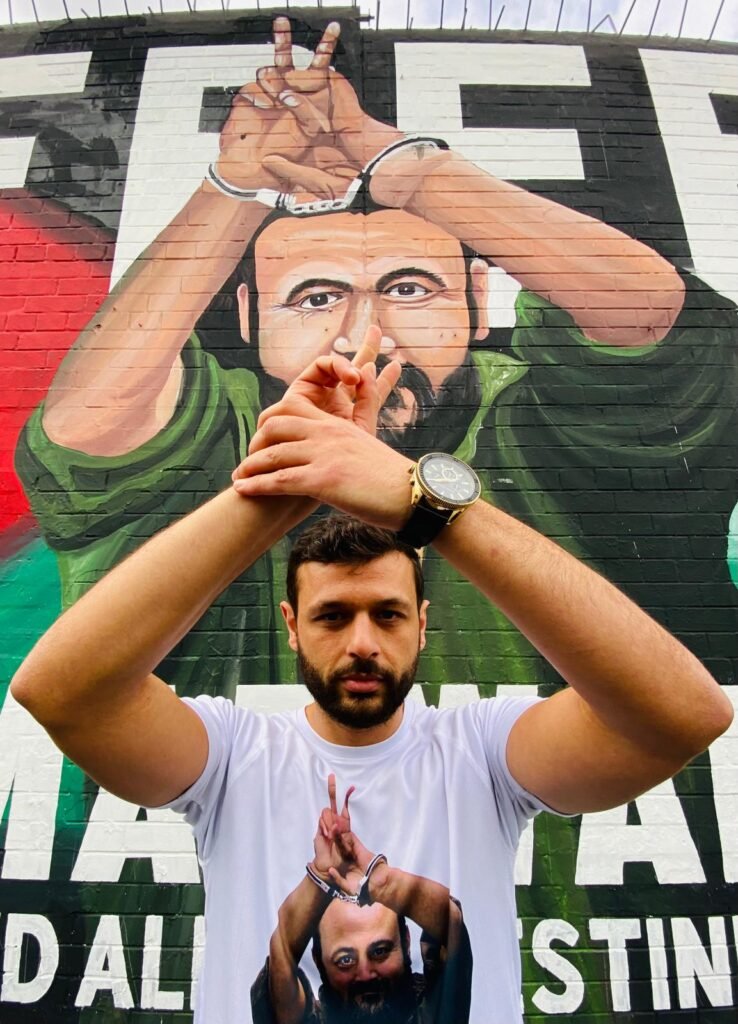
He has been imprisoned in Israel since 2002 for his alleged role in murders during the Second Intifada. He has been moved between maximum security facilities and faced long periods of solitary confinement, including one lasting three years. Recently, severe attacks on him have come to light and his appearance, on the occasion when he was forced to meet Ben Gvir, has shocked many, showing the signs of physical decline due to suffering maltreatment.
Marwan Barghouti is a life-long politician. He was elected a member of the Palestinian Legislative Council representing Fatah. During the Second Intifada, Israel targeted him and accused him of being a chief instigator of the some of the attacks that were executed in that uprising. In 2002, Israeli soldiers, disguised as medics in an ambulance, seized him from Ramallah, where he was serving as an elected parliamentarian. He was taken to Israel in violation of the Geneva Conventions, convicted of planning attacks that killed five people and was accorded five life sentences for murder.
In the trial, he disputed the legitimacy of Israel’s presence in the Occupied Palestine Territories and offered no formal defence in the court, the legitimacy of which he refused to recognise. He also denied any link to the attacks.
The trial itself was condemned by the Inter-Parliamentary Union as deeply flawed, with “numerous breaches of international law” making it “impossible to say that Mr. Barghouti received a fair trial.” Yet he was sentenced to five life terms plus 40 years.